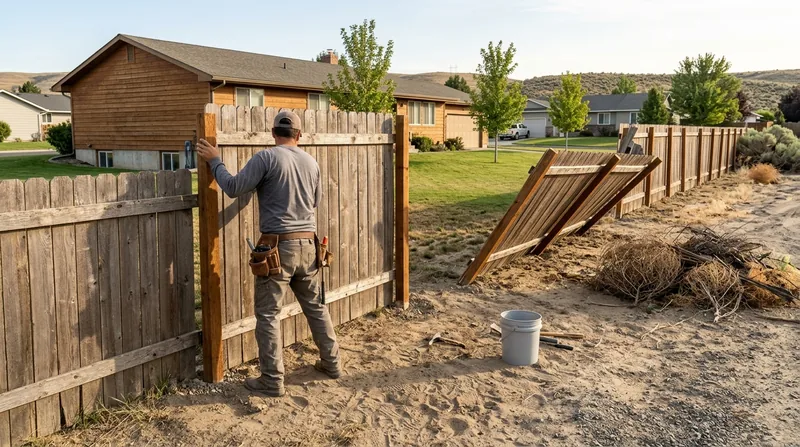




Spring and fall windstorms across the Columbia Basin regularly push over fence sections in Kennewick, Richland, and West Richland. When a storm damage fence repair is needed after a dust-storm gust front or high wind event, the damage is often immediate and visible: panels blown flat, posts snapped at the base, or entire sections leaning away from the property line. The semi-arid terrain and open sky of the Tri-Cities mean wind loads hit hard and fast, especially on six-foot tan vinyl privacy fence and cedar board-on-board installations that dominate residential lots here. We assess the damage on-site, document it with photos and a written estimate to help your insurance claim, and rebuild fallen sections to the same line and appearance, using stronger posts set deeper in concrete to resist the next blow.
Why Wind and Storm Damage Hits Hard on Kennewick Fences
Kennewick's high-desert location and wide-open lots make fences vulnerable to spring and fall windstorms. Unlike coastal areas with dense tree cover or humid regions where soil stays moist and stable, the Columbia Basin's fine silt and sand soil dries out quickly, loosening post bases and reducing lateral support. Vinyl and wood panels catch wind like sails, and posts set in loose tamped soil or shallow concrete can pivot and fail under sustained gusts. The typical Kennewick home sits on a flat or gently sloping lot with minimal windbreaks, so a fence often bears the full force of a dust-storm gust front without protection.
- Posts set in loose soil move and flex, causing concrete to crack and posts to lean or snap.
- Long vinyl or wood panels amplify wind load, especially on taller six-foot privacy fences common in newer subdivisions.
- Frozen ground in winter cold snaps can heave posts upward, breaking the concrete seal and weakening the base.
- Sprinkler systems and landscape irrigation keep soil wet at the post base, accelerating rot and post failure over time.
- Locust, poplar, and maple windbreak trees shed large branches and limbs that strike fences and damage panels and rails.
These conditions mean that storm damage often recurs unless the rebuild addresses the root cause: shallow posts, loose soil, or weak concrete.
Key info: After a spring windstorm near Southridge or a dust-storm gust front in West Richland, a fallen vinyl privacy fence section can look intact but the posts are usually compromised. We rebuild with posts set 36 to 42 inches deep in concrete, not tamped soil, to anchor against the next wind event.
See our full fence repair service for ongoing maintenance and structural fixes.
How We Handle Storm Damage Fence Repair in Kennewick: Step-by-Step
When you call after a windstorm, we schedule a same-day or next-day damage assessment. We photograph the fallen or damaged sections, measure the span and height, identify the post condition, and note soil and terrain factors that contributed to the failure. We then provide a written estimate that documents the damage and cost to rebuild, which you can submit to your homeowner's insurance. Our crew removes the damaged section, sets new posts in concrete below the frost line, installs new rails and pickets or panels to match the original fence, and ensures the repair is stronger than the original installation.
- We arrive on-site to assess wind damage and photograph the fallen fence section for your insurance claim.
- We measure the span, post spacing, and panel height to ensure the rebuilt section matches the existing fence.
- We remove damaged posts and panels and dispose of debris off-site.
- We set new posts in concrete below the frost line to prevent heave and improve wind resistance.
- We install new rails, pickets, or panels in the same material and style as the original fence.
- We verify post plumb, rail alignment, and gate operation before we finish.
A typical storm damage repair on a single section takes one to two days, depending on post condition and material availability.
Example: A homeowner in Kennewick's Canyon Lakes area lost a 16-foot vinyl privacy fence panel after a spring windstorm. The original posts were set only 24 inches deep in loose tamped soil. We removed the damaged section, reset new posts 40 inches deep in concrete, and installed matching vinyl panels. The rebuilt section now resists wind loads far better than the original, and the homeowner's insurance covered the full repair cost.
Learn more about fence post repair and replacement when posts are damaged or rotted.
Storm Damage Fence Repair Methods and Approaches
| Approach | Description | Best for |
|---|---|---|
| Section replacement | Remove fallen or damaged panel, set new posts in concrete, install new rails and pickets or vinyl panels to match existing fence. | Wind damage, fallen panels, or snapped posts when the rest of the fence is sound. |
| Post reinforcement | Dig out existing post, set deeper in concrete, or install anti-sag bracing to stabilize leaning sections without full replacement. | Posts that are leaning but not broken, or when deeper concrete setting strengthens the existing base. |
| Full fence replacement | Remove entire fence line, set new posts, install new rails, pickets, or panels throughout the property. | Multiple sections damaged, posts rotted or failed along the line, or when repair costs approach replacement value. |
| Material upgrade | Rebuild damaged section in a more durable material, such as vinyl or pressure-treated pine, to reduce future wind damage risk. | Repeated storm damage, aging cedar that cracks and grays in Kennewick's intense UV and dry heat, or when homeowner wants a lower-maintenance fence. |
Storm Damage Fence Repair Cost in Kennewick: What to Expect
A free damage assessment is the first step. We arrive on-site, photograph the damage, measure the fallen or damaged section, and provide a written estimate. The cost to rebuild a single section of vinyl or wood fence typically ranges from $800 to $2,500, depending on the panel height, post spacing, material, and soil conditions at the site. Cedar or pressure-treated wood sections cost less than vinyl, but vinyl requires less maintenance in Kennewick's hot, dry climate. If multiple sections are damaged or posts are rotted throughout the fence line, a full replacement may be more cost-effective than piecemeal repairs. Most homeowner's insurance policies cover sudden windstorm damage to fences, so submitting our estimate and photos to your insurance carrier often reduces your out-of-pocket cost significantly.
Factors that affect the final cost include panel height (six-foot privacy fence costs more than four-foot), post spacing and the number of posts needed, soil type and whether posts must be set deeper or in concrete versus tamped soil, proximity to utilities or structures that limit access, and the material you choose for the rebuild. We always recommend getting two or three estimates before committing, so you understand the scope and can compare pricing and approach across contractors.
See our full pricing overview for detailed cost guidance by material and service type.
What to Look for When Hiring a Fence Contractor Near Me in Kennewick
When you need storm damage fence repair near Kennewick, choose a contractor who is fully insured, responds quickly to emergency calls, and has experience with the specific materials and soil conditions in the Tri-Cities. In Washington, fence licensing is set by county and city code, and the requirements vary across Kennewick, Richland, West Richland, and Benton City. Some jurisdictions require a permit for fence repair or replacement, especially if the fence is in a historic district or near a property line. Always verify permit requirements with your local building department before work begins, and check whether your HOA has architectural standards that govern fence height, material, or color in your subdivision.
- Confirm the contractor is fully insured and can provide a certificate of insurance covering general liability and workers' compensation.
- Check references from recent storm damage repairs or fence installations in Kennewick or nearby Richland and West Richland.
- Ask about their approach to post setting: posts should be set in concrete below the frost line, not tamped soil, to resist wind loads.
- Verify that the contractor will call 811 for a utility locate before digging post holes, as required by Washington law.
- Confirm that the contractor has experience with the material you want: vinyl, cedar, pressure-treated pine, or chain link.
- Get a written estimate that includes material, labor, and a timeline for completion and insurance claim documentation.
Call us at (509) 581-6734 for a free damage assessment and estimate after a storm. We respond within 24 hours and help you document the damage for your insurance claim.
Storm Damage Fence Repair in Kennewick: Pricing Guide
| Service | Price | Details |
|---|---|---|
| Free damage assessment | Free | On-site inspection, photos, measurements, and written estimate to support your insurance claim |
| Single section rebuild (vinyl or wood) | Starting at $1,200 | Includes new posts set in concrete, rails, and panels to match existing fence up to six feet tall |
| Post replacement and reinforcement | Starting at $400 per post | Remove damaged post, reset new post deeper in concrete, or install anti-sag bracing for leaning sections |
| Full fence replacement | On estimate | Cost depends on total linear footage, material type, soil conditions, and site access; typically $18-$35 per linear foot |
| Travel and emergency calls | Included | No mileage fee or travel charge in Kennewick, Richland, West Richland, and surrounding Tri-Cities areas |
Indicative pricing, the exact cost depends on square footage, finish, and site access. Free personalized estimate within 24h at (509) 581-6734.


