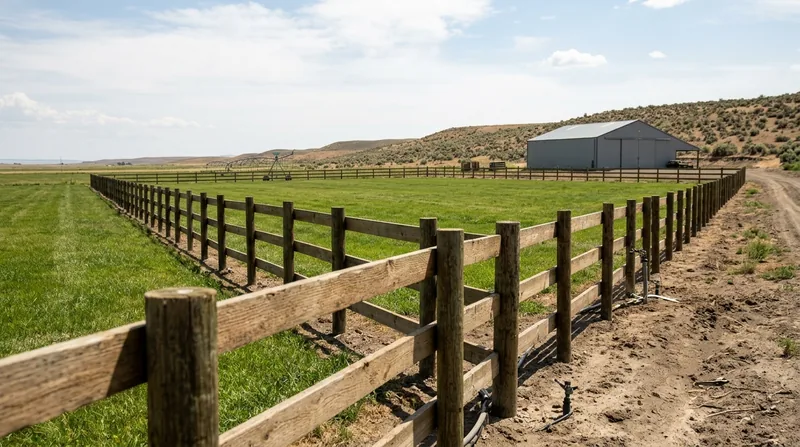




Acreage across the Columbia Basin demands fencing built to stand against high desert wind, intense UV, and the scale of working land. Farm fence installation in Kennewick covers ranch rail, no-climb horse fence, field wire, and pipe fencing on properties in Finley, Badger Canyon, and the open country stretching toward Prosser and Walla Walla. Posts set deep in loose silt and sand, braced corners holding against spring and fall windstorms, and gates sized for trailers and equipment are the difference between a fence that lasts and one that tips over under load. We work across Benton, Franklin, and Walla Walla counties with straight lines over long open runs, crews who understand how to build on irrigated acreage where ground stays wet at the post base and freeze-thaw cycles crack concrete footings. This is not residential vinyl or chain link; this is fencing that has to move cattle, hold horses, and survive the high-desert climate for 15 to 25 years.
Why Ranch and Farm Fencing Matters in the Kennewick Area
Properties on acreage in and around Kennewick face unique fencing challenges that suburban lots do not. Soil here is fine wind-blown silt and sand over gravel and caliche, loose and dry until irrigation soaks it, then prone to heave and settlement as ground freezes and thaws through winter. Posts that are not set deep enough tip when wind hits a long panel, and posts set in tamped earth alone shift as water moves through the soil. Horses and livestock need fencing that will not sag or fail under pressure, and gates need to swing true and close reliably after hundreds of cycles per year. Ranch properties also demand straight lines and proper corner bracing over distances where even a 1-degree drift becomes visible and problematic at the far end of a 100-foot run.
- Posts set in concrete footings 3 to 4 feet deep anchor against frost heave and soil movement in high-desert conditions.
- Braced corners and anti-sag hardware prevent panel sagging on long open runs exposed to spring and fall windstorms.
- Proper gate sizing and self-closing hardware keep animals contained and equipment access reliable across seasons.
- No-climb horse fence and field wire prevent injury and escape while standing up to chewing, leaning, and weather for decades.
Building farm and ranch fencing to code and to the land itself is what separates a working fence from a liability.
Key info: Acreage in Finley and Badger Canyon often sits on irrigation ditches and shared water lines. Washington 811 utility locates are required by law before digging any post holes. Call 811 before we arrive, or we can coordinate the locate and mark for you at (509) 581-6734.
For more on fence installation across the region, see our service areas.
How We Install Farm and Ranch Fencing in Kennewick and Beyond
Ranch fencing starts with a site walk and honest assessment of soil, wind exposure, and the work the fence has to do. We measure the perimeter, identify corners and gates, and plan post spacing and bracing before we dig. Loose silt and sand in the Columbia Basin means posts must go deep and concrete must set properly, so we do not rush the foundation work. Corners get cross-bracing, long runs get anti-sag hardware, and gates are hung level and plumb so they close without binding or drifting. Every job starts with a 24-hour free estimate and a clear scope of work.
- Call (509) 581-6734 or request an estimate online, and we schedule a site visit within 24 hours.
- We walk the property, identify utilities with an 811 locate, and measure the perimeter and any slopes.
- We provide a written estimate showing post count, linear footage, materials, and the total price with no surprises.
- Once you approve, we set a start date and coordinate any permits or HOA approvals required by your county or community.
- We mark post locations, dig footings to frost depth, set posts in concrete, and install rails, wire, or pipe in straight lines.
- Gates are hung, tested, and adjusted so they swing freely and close reliably.
- We clean up debris and walk the line with you before invoicing.
The result is a fence that works for the land and the climate where it stands.
Local example: A 5-acre property in Badger Canyon with split rail fencing on three sides and a gate opening to a gravel road typically runs 400 to 600 linear feet. Posts spaced 6 feet apart, set 3.5 feet deep in concrete, with cross-bracing at corners and a 12-foot gate hung on self-closing hardware takes 4 to 6 days and costs from $4,800 to $7,200 depending on rail material and slope.
See our gate installation and repair page for details on heavy-duty gates and operators.
Farm and Ranch Fencing Methods and Materials
| Approach | Description | Best for |
|---|---|---|
| Split Rail Fence | Horizontal cedar or pressure-treated rails mortised into posts, classic ranch look, posts spaced 6 to 8 feet apart. | Acreage, horse properties, long sightlines, heritage aesthetics. |
| No-Climb Horse Fence | Vinyl-coated welded wire mesh in a rigid frame, 4x4 inch or 2x4 inch openings, prevents hooves and heads from catching. | Horse and livestock containment, high-traffic areas, long-term durability in intense UV. |
| Pipe and Post Fencing | Galvanized steel pipe or tubing welded or bolted to posts, extreme strength, withstands heavy wind and snow load. | Large acreage, equipment and vehicle containment, areas with extreme weather exposure. |
| Field Wire and Barbed Wire | Galvanized field or barbed wire strung between posts and tightened with tension bands and stretcher bars for secure closure. | Cattle containment, perimeter security, cost-effective long-distance fencing on open land. |
Each method is built to local soil and climate. Posts are set 3 to 4 feet deep in concrete, corners are cross-braced, and long runs include anti-sag hardware to keep lines straight through seasonal freeze-thaw and wind.
Farm and Ranch Fencing Cost in Kennewick: What to Expect
Ranch and farm fencing is priced per linear foot, but the total depends on what the fence has to do, the terrain it crosses, and the materials you choose. Farm and ranch fencing starts at approximately $12 per linear foot for basic field wire on flat, open ground with no obstacles. Split rail and no-climb horse fence run higher because they require more material and labor, and pipe fencing is the most expensive because it demands welding and heavy equipment. Posts set on slopes require stepped or racked installation, which takes more time and materials. Corners need cross-bracing, and gates add labor and hardware cost. The best way to know your actual cost is to get a free estimate on site, where we can see the soil, measure the run, and account for access and any complications.
Factors that move the price up include acreage and distance (long runs need more materials and labor), terrain and slope (stepped installation costs more), soil conditions (loose silt and sand require deeper footings and more concrete), tree or rock obstacles (we work around them or remove them), and gate size and hardware (heavier gates and self-closing mechanisms add cost). We always provide a written estimate before we start, and we do not charge extra for site visits or estimates.
For a complete pricing overview and examples, see our pricing page.
What to Look for When Hiring a Farm and Ranch Fence Contractor Near Kennewick
Fencing on acreage is a significant investment and a long-term asset, so hiring the right contractor matters. Look for a crew with local experience building on irrigated land and in high-desert wind, who understand how soil and climate affect post depth and bracing. Ask to see examples of ranch fencing they have installed in the area, and call references who own acreage. Get written estimates from at least two contractors so you can compare scope, materials, and price. Check that the contractor carries full insurance and workers' compensation cover, because a post hole accident or injury on your property becomes your liability if the contractor is not insured. Ask about permits, HOA approvals, and utility locates before digging; in Washington, every contractor is required to comply with 811 utility locate law, and some counties require building permits for farm structures. Verify that the contractor understands your county's setback rules, height limits, and any deed restrictions that apply to your property. If you are unsure about property lines, the only reliable way to know is a survey by a licensed land surveyor; we install on the line you identify, but we do not determine boundaries.
We are fully insured and can provide a certificate of insurance on request. Call us for a free estimate at (509) 581-6734, and we will walk your property, explain the work, and give you a clear price before you commit.
Farm & Ranch Fencing in Kennewick: Pricing Guide
| Service | Price | Details |
|---|---|---|
| Split Rail Fence | Starting at $18/ft | Cedar or pressure-treated rails, posts set 3.5 feet deep in concrete, includes cross-bracing at corners and anti-sag hardware |
| No-Climb Horse Fence | Starting at $16/ft | Vinyl-coated welded wire mesh, rigid frame, posts set to frost depth, ideal for long-term durability in high-desert UV |
| Field Wire and Barbed Wire Fencing | Starting at $12/ft | Galvanized wire strung tight with tension bands and stretcher bars, posts set 3 to 4 feet deep, cost-effective for large acreage |
| Pipe and Post Fencing | Starting at $22/ft | Galvanized steel pipe welded or bolted to posts, extreme strength for wind and snow, requires specialized equipment and welding labor |
| Gates and Hardware | From $400 to $1,200 | Depends on gate width, material, hinges, and self-closing or self-latching hardware; larger gates for trailers and equipment cost more |
| Free Estimate | No charge | Response within 24 hours at (509) 581-6734, includes site walk, utility locate coordination, and written scope with no obligation |
Indicative pricing, the exact cost depends on square footage, finish, and site access. Free personalized estimate within 24h at (509) 581-6734.


